



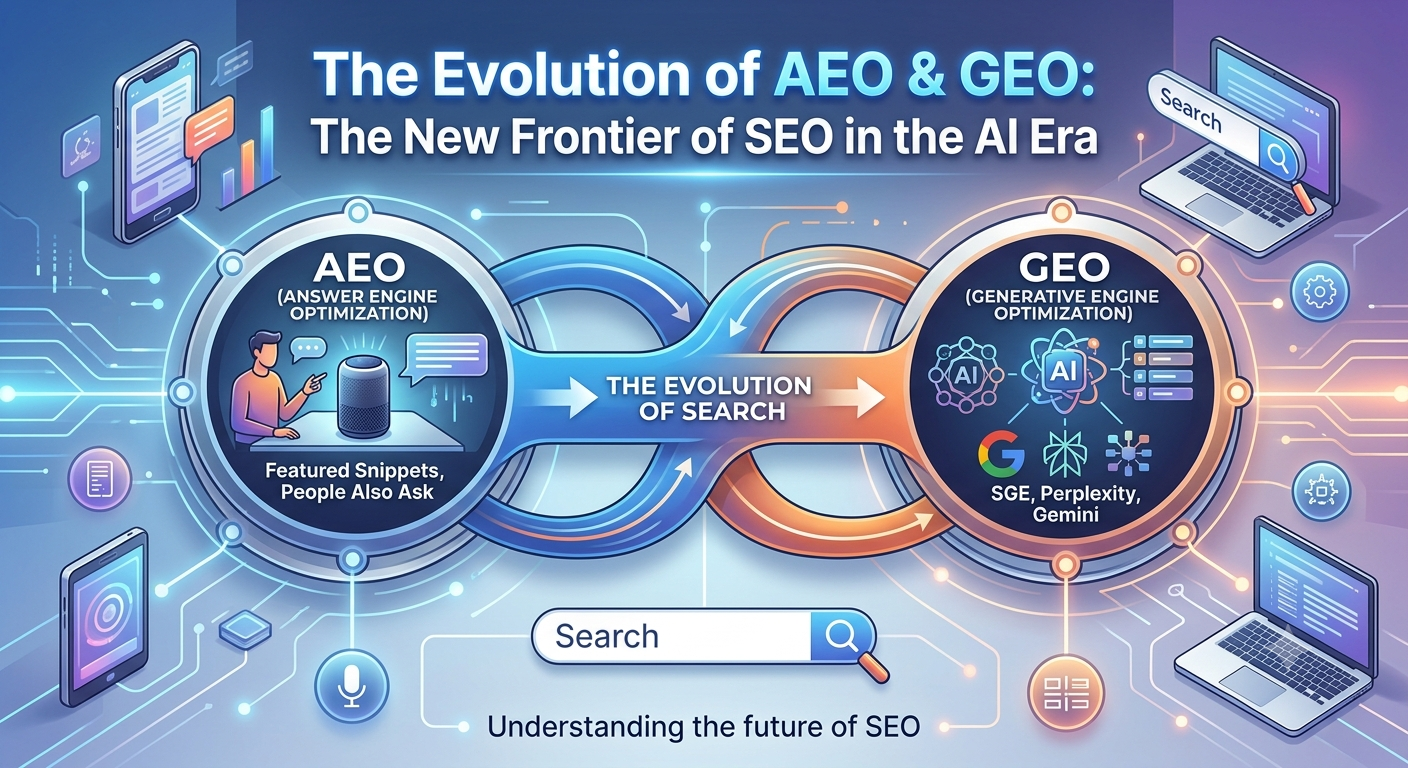

The landscape of search engine optimization is undergoing a monumental shift. The days of simply optimizing for keywords on a results page are long gone. Today, we are witnessing the rise of advanced technologies that have fundamentally changed how users find information, and SEO strategies must adapt to keep up. Two concepts that are critical to this evolution are Answer Engine Optimization (AEO) and Generative Engine Optimization (GEO).
These are not just buzzwords; they represent the new frontier of SEO. To succeed in this AI-driven era, it’s essential to understand what AEO and GEO are, how they have evolved, and how you can optimize your content for them.
What is AEO (Answer Engine Optimization)?
Answer Engine Optimization (AEO) is a specific type of SEO focused on getting content included directly within search result summaries, which are often called “rich results” or “featured snippets.” The core goal of AEO is to provide the single best, most concise answer to a user’s question, which often gets pulled right to the top of the search engine results page (SERP) or is spoken back by a voice assistant.
The Evolution of AEO
AEO isn’t new. It’s been evolving for years, parallel with the growth of:
-
Voice Search: Devices like Amazon Alexa, Google Assistant, and Apple’s Siri require clear, direct answers, pushing the focus away from a simple “list of links.”
-
Featured Snippets: Google started presenting concise information directly at the top of the SERP, forcing content to be structured in a way that’s easy for machines to extract.
-
Knowledge Panels: These sections provide pre-formatted, concise info about people, places, and things, pushing website owners to structure their data.
Today, AEO is less about optimizing for specific keywords and more about optimizing for user intent and natural language.
Key AEO Ranking Factors
To optimize for AEO, you must provide clear answers, use structured data, and establish a high level of authority. Here are some critical factors:
-
Natural Language Processing (NLP): Use direct answers and natural, conversational language.
-
Structured Data (Schema Markup): Implement precise schema like FAQ, “How-To,” and Q&A markups.
-
Concise Content: Focus on bullet points, tables, and short paragraphs.
Introducing GEO (Generative Engine Optimization)
While AEO focuses on providing specific answers, Generative Engine Optimization (GEO) takes it a step further. It is the process of optimizing content to be included in the results generated by AI-powered large language models (LLMs), like Google’s Search Generative Experience (SGE), Perplexity, and OpenAI’s ChatGPT.
Understanding the Shift to GEO
The key difference with GEO is the “generative” part. These models don’t just find a existing webpage; they synthesize new content from multiple sources to directly answer a user’s complex query. They can combine information from articles, forums, reviews, and images to create a unique summary.
SEO vs. AEO vs. GEO: A Breakdown
| Feature | Classic SEO | AEO (Answer Engine) | GEO (Generative Engine) |
| Primary Goal | High rankings in SERP. | Being the direct answer to a query. | Being cited by an AI in a synthesized response. |
| Input | Keywords, backlinks, technical structure. | Natural language, schema markup, direct answers. | Natural language, authoritative content, structured data. |
| Output | List of relevant links with titles/descriptions. | A single concise answer (snippet, voice reply). | A generated, synthesized summary with citations. |
| Key Metrics | Organic Traffic, CTR. | Voice search share, snippet impressions. | Citation volume, inclusion in generative summaries. |
| User Intent | Information gathering, transactional. | Immediate answers, “how-to.” | Explanatory, comparative, syntheses of topics. |
The Combined Future: Why SEO Now Means AEO + GEO
If you only focus on classic SEO, you are missing a massive portion of the market. The real future isn’t an “either/or” scenario; it’s about integrating all three approaches.
Content that wins in AEO is more likely to be used as a primary source by GEO models. They are highly correlated. Here’s why and how they evolve together:
-
Natural Language is Key: Both AEO and GEO are heavily reliant on content being structured and written for people, not just machines.
-
Credibility Matters More than Ever: In the age of AI hallucinations, AEO and GEO systems prioritize trustworthy, authoritative sources. This makes E-E-A-T (Experience, Expertise, Authoritativeness, and Trustworthiness) your most critical asset.
-
Structure Provides Context: Schema markup isn’t optional. It provides the necessary context to help both answer and generative engines understand your content.
User Search Intent is Changing: How to Optimize Your Content
Users have evolved. Their search queries are more conversational and detailed. They aren’t just searching for “best pizza nyc”; they might search for “What’s the best affordable pizza in the East Village that is good for a large group?”
To address this:
1. Optimize for Question-Based Queries
Your content should proactively answer questions your target audience is asking. Use an FAQ format, or structure your blog post as a series of direct answers to common queries.
-
Bad: Title: “The Best Project Management Software”
-
Good: Title: “Which Project Management Software is Best for Remote Teams of 10+?”
2. Implement and Use Schema Markup
This is your #1 technical priority. Ensure your FAQ pages, reviews, product pages, and blog posts are marked up. Structured data is the universal language that tells search engines and AI models exactly what your content means.
3. Focus on Deep Content, Not Superficial
GEO models are excellent at synthesizing information. To get their attention, your content needs to be truly comprehensive. Instead of a surface-level 800-word post, go for a 2,000-word piece that is the definitive guide on the topic. Provide evidence, unique insights, and original research.
The Future of SEO is Integrated
The landscape is changing rapidly. While classic SEO will remain a factor, the primary driver for organic visibility is shifting toward AEO and GEO. Don’t think of them as additional work; think of them as the natural evolution of how search works.
By focusing on natural language, deep authority, and clear structure, you can optimize your content for the answer and generative engines that are defining the future of search.
Check out more blogs at: https://www.sakshamkhandelwal.in/